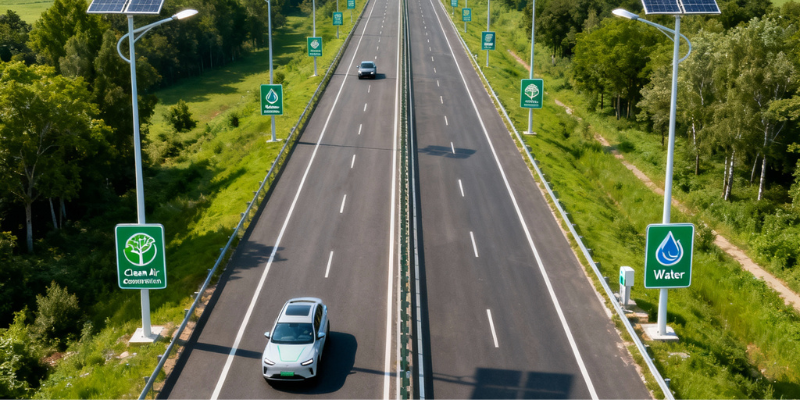
In the race toward modern connectivity, greenfield roads have emerged across the world as symbols of progress and economic transformation. Unlike brownfield projects that upgrade existing infrastructure, greenfield corridors carve entirely new routes through undeveloped regions by enhancing mobility, reducing travel time and linking remote economies with national and regional markets. From transcontinental expressways in Africa and Asia to cross-border logistics corridors in Europe and Latin America, countries are increasingly turning to greenfield development as a cornerstone of trade facilitation and regional integration.
However, as this global infrastructure push gathers pace, a common realization has taken root: the quest for connectivity must not come at the cost of ecological balance. The 21st century has seen an unprecedented expansion of transport networks to support trade, urbanization and industrial growth, but it has also revealed the environmental price of unchecked development. New roads often cut through forests, wetlands, and farmlands, leading to habitat loss, carbon emissions, and community displacement. As a result, nations worldwide are now striving to balance economic dynamism with environmental responsibility, embedding principles of climate resilience, sustainable land use, and biodiversity conservation into infrastructure planning.
This evolving paradigm reflects a crucial shift from viewing greenfield roads merely as pathways to growth to recognizing them as critical test cases for sustainable development. The challenge before the global community is not whether to build, but how to build better, ensuring that every kilometre of progress also strengthens our collective commitment to a greener, more balanced future.
Across the world, connectivity is expanding at an unprecedented pace. Countries are investing heavily in new transport corridors—from expressways cutting across China’s inland provinces to Africa’s Trans-Sahel highways and Latin America’s bio-oceanic routes; each designed to boost regional trade, improve mobility, and bridge economic gaps. This surge in infrastructure has become a cornerstone of global development, enabling smoother logistics and deeper economic integration across continents.
Yet, this expansion has also come at a visible ecological cost. Studies show that transport infrastructure contributes nearly one-quarter of global energy-related CO₂ emissions—about 8 billion tonnes annually (IEA, 2022), with road networks accounting for the largest share. New alignments often cut through forests, wetlands, and agricultural zones, causing habitat loss, biodiversity fragmentation, soil erosion, and water pollution. The environmental footprint extends far beyond the asphalt: when roads open previously untouched landscapes, they trigger secondary deforestation, unplanned settlements, and resource depletion.
As the global demand for connectivity intensifies, greenfield development has emerged as both a necessity and an opportunity, a way forward that can reconcile growth with sustainability if guided by thoughtful planning and ecological foresight. The question is no longer whether to build, but how to build better; ensuring that the drive for development is matched by equal commitment to environmental preservation.
Globally, the sustainability debate has shifted from “build versus protect” to “build responsibly.” Most countries now integrate environmental safeguards across the entire road lifecycle—from design and materials to maintenance and decommissioning.
Lifecycle Assessment (LCA) and Lifecycle Cost Analysis (LCCA) are now standard tools. By examining energy use and emissions from extraction to end-of-life, LCAs reveal that embodied carbon in road materials can represent up to 30–40% of total lifecycle emissions. As a result, the emphasis is moving toward:
● Low-carbon materials: Warm-Mix Asphalt (WMA) technologies reduce fuel use and greenhouse gases by 10–30% compared with traditional Hot-Mix Asphalt.
● Recycled aggregates: Reclaimed Asphalt Pavement (RAP) and Reclaimed Asphalt Shingles (RAS) replace virgin materials, lowering both cost and carbon footprint.
● Green construction practices: Using solar-powered batching plants, bio-bitumen, and dust-suppression systems to minimize local air and water pollution.
● Wildlife crossings: Meta-analyses show that crossings combined with fencing can reduce roadkill by 40–54%, restoring ecological connectivity.
In Europe, “Green Road” standards under the EU Green Deal now tie financing to compliance with emissions and biodiversity criteria. The U.S. Federal Highway Administration promotes Infrastructure Carbon Estimation Tools (ICE), while Japan’s “Eco-Road” framework quantifies biodiversity offsets. Collectively, these examples signal a global transition from carbon-intensive to nature-positive infrastructure.
Global R&D and Innovation Landscape
Research and innovation are reinforcing this shift. Universities and transport agencies worldwide are developing next-generation materials and digital tools:
● Material Science Innovations:
Laboratory trials in the U.S., Europe, and South Korea show that warm-mix and polymer-modified binders can cut plant-stage energy use by up to 20 MJ/tonne while enhancing durability. Pilot projects combining WMA with bio-bitumen from algae and lignin indicate further carbon reductions.
● Circular Economy Approaches:
Road-grade plastic and rubber recycling has become mainstream in countries like the Netherlands and Australia, where over 60% of asphalt now contains recycled content. R&D on nano-additives and rejuvenators extends the life of recycled pavements.
● Digital and Ecological Design:
AI-based alignment software integrates geospatial and ecological data to avoid sensitive zones. LiDAR and satellite imagery map wildlife corridors, guiding placement of overpasses and culverts.
These innovations reveal a unifying trend: sustainability is no longer a cost centre but a value driver enhancing longevity, reducing maintenance, and unlocking green finance.
India’s Development Imperative
India’s infrastructure ambitions are both vast and transformative. The country’s National Highways network now extends over 1.46 lakh kilometres, with more than 26,000 km of new highways awarded and nearly 20,000 km constructed under the Bharatmala Pariyojana as of early 2025. This unprecedented expansion forms the backbone of India’s economic growth—linking manufacturing hubs, ports, logistics parks, and rural regions to create seamless national connectivity and foster regional equity.
However, India’s extraordinary ecological diversity from the rainforests of the Western Ghats to the fragile Himalayas of the Northeast demands that this growth be environmentally responsible. The nation thus faces a defining challenge: how to sustain the speed and scale of infrastructure development while safeguarding its natural ecosystems. The path forward must integrate innovation, resilience, and sustainability—ensuring that every kilometre built strengthens not just India’s economy, but also its ecological future.
India’s Sustainability Framework for Greenfield Roads
1. Green Highways Policy (2015)
India’s Green Highways Policy mandates that 1% of every highway project’s civil cost be devoted to tree plantation and maintenance. This has enabled the creation of green corridors for erosion control, dust reduction, and local employment. Over the years, the policy has evolved to include community partnerships, where local self-help groups and NGOs are responsible for plantation survival.
2. PM Gati Shakti and Spatial Intelligence
The PM Gati Shakti National Master Plan overlays over 200 GIS layers covering forests, wildlife reserves, water bodies, and habitations to ensure that new routes avoid ecologically sensitive areas. This data-driven approach marks India’s move from reactive mitigation to predictive planning.
3. Biodiversity and Mitigation Measures
Wildlife underpasses and canopy bridges have been incorporated into corridors such as NH-44 (Kanha–Pench) and NH-275 (Bengaluru–Mysuru). Early monitoring shows a decline in animal-vehicle collisions, reflecting the effectiveness of science-based mitigation.
4. Sustainable Construction Practices
India is scaling use of waste plastics in bituminous mixes—initially mandated near urban areas but now expanding nationwide. The National Highways Authority of India (NHAI) reports over 703 km of plastic roads built by 2024. Similarly, fly ash utilization from nearby power plants in embankment construction reduces waste and cement demand.
5. Green Operation and Maintenance (O&M)
Post-construction, focus is shifting toward smart monitoring and maintenance. Internet-of-Things sensors track pavement temperature and drainage; drone audits verify plantation survival. Intelligent Transport Systems (ITS) pilots in urban corridors have shown 30–40% reductions in travel time, indirectly lowering vehicular emissions.
India’s Research and Development Ecosystem
India’s R&D momentum in road infrastructure mirrors global sustainability trends but is firmly grounded in local materials, climatic conditions, and policy priorities. The country is increasingly shifting from theoretical innovation to applied, field-tested solutions that can be scaled through national programs like Bharatmala and PM Gati Shakti. Here is a table which reviews India’s R&D ecosystem :
| Focus Area |
Key Institutions / Agencies |
Technology or Research Focus |
Technology Transfer / Implementation Status |
Impact |
| Material Innovation |
IIT Delhi, IIT Madras, CRRI, NHAI |
Warm-Mix Asphalt (WMA) formulations for Indian climate and aggregates |
Field trials completed in Delhi, Pune, Chennai; MoRTH integrating results into IRC specifications |
10–15% energy saving, reduced emissions, improved compaction and pavement life |
| Circular Resource Use |
MoRTH, IIT-BHU, NITs, State PWDs |
Use of waste plastics, rubber, and e-waste-derived polymer modifiers in bitumen |
Pilot projects on National Highways and urban stretches; training modules for PWD engineers |
Waste diversion from landfills; reduced bitumen demand; better rut resistance |
| Lifecycle Assessment (LCA) Development |
CRRI, NHAI, Indian Roads Congress |
Standardized LCA templates and carbon-intensity metrics for DPRs |
Under validation; being integrated into DPR documentation and tender evaluation |
Enables carbon accounting, climate financing, and data-driven project selection |
| Ecological Engineering |
Forest Departments, WII, MoEFCC, NGOs, IITs |
Wildlife crossing typologies, ecological monitoring, terrain-specific designs |
Camera trap data and GPS tracking informing MoRTH manuals; ongoing integration in new greenfield projects |
Improved wildlife safety, reduced roadkill, model guidelines for future corridors |
| Slope & Soil Stabilization (Bioengineering) |
IIT Roorkee, CSIR-CRRI, NHIDCL |
Vegetative slope stabilization, coir/geogrid reinforcement, bio-engineered embankments |
Demonstration sites in Northeast and Himalayan roads; knowledge transfer workshops with NHIDCL |
Reduced erosion, lower maintenance costs, increased slope resilience |
| Digital & Data-Driven Planning |
MoRTH, NIC, PM Gati Shakti NMP |
Integration of GIS, LiDAR, and drone-based terrain mapping in planning |
Operational across all Bharatmala projects; 200+ GIS layers used in route selection |
Minimized environmental conflicts, optimized land use, faster project clearances |
| Capacity Building & Knowledge Transfer |
Indian Academy of Highway Engineers (IAHE), NHEIP, World Bank |
Training programs, manuals, and field visits on sustainable materials and practices |
Continuous professional training for engineers and contractors nationwide |
Accelerates adoption of sustainable technologies across PWDs and NH agencies |
The Social Dimension of Sustainability
Sustainability is not limited to materials, emissions, or technology—it is fundamentally about people. Every new greenfield corridor passes through living landscapes—villages, tribal belts, agricultural lands, and forest fringes—that are home to communities whose lives are directly shaped by these projects. When thoughtfully designed and inclusively implemented, greenfield roads can become instruments of empowerment rather than disruption.
Engaging local populations transforms infrastructure from an external imposition into a shared community asset. For example, under initiatives linked to the Green Highways Policy and KVIC’s Honey Mission, local self-help groups—particularly tribal and women’s collectives—have been entrusted with the creation and maintenance of roadside plantations, nurseries, and apiculture clusters along highway corridors. These programs generate steady incomes, revive traditional ecological knowledge, and ensure that green belts remain well maintained. In Madhya Pradesh and Chhattisgarh, such collaborations have led to thriving “bee villages” along national highways, where local women now produce honey and wax products marketed under the Khadi India brand.
Similarly, in the Northeastern and Himalayan states, where terrain and ecology are fragile, the introduction of bioengineering measures—like coir matting, bamboo fencing, and vegetative slope stabilization—has created new employment opportunities for local artisans and farmers. These practices blend traditional craft with modern engineering, offering sustainable livelihood options while safeguarding the environment.
Such efforts highlight how greenfield development, when embedded with social responsibility, becomes a bridge between ecology and equity. It transforms infrastructure projects into ecosystems of opportunity—providing income, fostering ownership, and building resilience among the most marginalized. This inclusive approach echoes the principle of Antyodaya—reaching the last mile, ensuring that progress does not bypass the very communities it is meant to uplift.
Ultimately, greenfield corridors can symbolize hope—not just as highways of commerce, but as corridors of empowerment, where development travels hand in hand with dignity, participation, and shared prosperity.
The Way Forward
For India—and the world—greenfield infrastructure must evolve from being merely “fast and functional” to being “smart, sustainable, and socially inclusive.” The roadmap involves:
1. Prioritizing avoidance: Use spatial data to steer clear of high-biodiversity and high-carbon areas.
2. Standardizing mitigation: Incorporate wildlife crossings, green belts, and erosion controls as mandatory design elements.
3. Decarbonizing materials: Mainstream WMA, RAP, and bio-bitumen blends to cut embodied carbon.
4. Adopting nature-based solutions: Use bio-engineering for slopes and wetland restoration for flood management.
5. Linking finance to outcomes: Tie project funding and contractor payments to verified environmental performance.
Greenfield roads symbolize progress, but their true success lies in how lightly they tread upon the earth. Global experience shows that with foresight, technology, and transparency, infrastructure can coexist with ecology. For India, integrating sustainability into every kilometre built under the vision of Viksit Bharat @ 2047 is both an environmental necessity and a moral imperative.