Role of Technology in Building India’s Infrastructure and Construction Industry
Total Views |


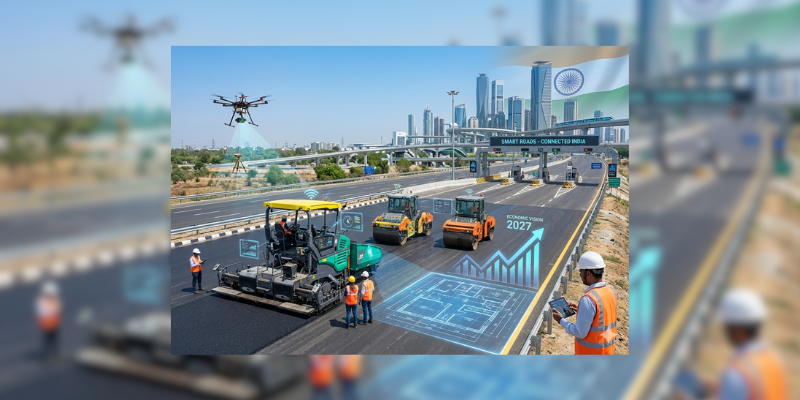
The roadways and highway sector is considered as most vibrant infrastructure. As India is becoming more connected, Indian roads are becoming better, demanding the need forefficiency in road construction with the right equipment. Government has a vision of economic development and the aim of achieving record economy by 2026-2027, by focusing on Infrastructure development. The updated use of technology has brought drastic changes in India’s Infrastructure and the Construction methodology and process too.
Questions & Answers
1. How are you sourcing construction equipment for your project execution needs?
Construction companies normally source equipment primarily through purchasing, leasing or renting depending on project-specific needs, budget and usage period strategy. The overall process is part of a larger procurement strategy
that aims to secure necessary resources on time and within budget. Sourcing construction equipment for our kind of road projects requires evaluating numerous technical, economic, site-specific, and project-specific criteria to maximize efficiency and ensure timely as well as cost-effective completion.
Project and site-specific criteria
The nature and magnitude of work like excavation, compaction, paving, material handling and the quantity of material to be cut-filled or moved will dictate the type and size of equipment needed. Our on-going greenfield access-controlled 6 laned highway project in Andhra Pradesh has seen tough challenges to blast, drill and move exceptionally hard rock, taking a toll on the excavators too. Besides, accessibility and the weather become determining factors in the selection process. We would evaluate the suitability of a crawler-mounted or wheel-mounted equipment for a site. We would also give a thought to what all can affect equipment performance, fuel consumption, for the choice of material used, for example, hot bitumen would require specific compactor reliability.
Equipment-Specific Criteria
Aspects like production capacity, the machine’s reliability and durability and its versatility in operations are definitely checked. Equipment capable of performing multiple functions (a tractor that can be used as a dozer or a loader with attachments or an excavator with multiple arm attachment options for drilling, rolling) can be more cost-effective for a company's overall fleet management. Besides this, the crucial factor of fuel efficiency and power also governs decisions.
Economic and Logistical Criteria
The total cost of ownership as well as operating and maintenance costs, the insurance, taxes, and potential salvage/resale value also need to be looked at. After-sales support and spare parts availability are critical to minimizing downtime, hence significant considerations. The availability of trained and skilled operators for specific machinery types influences the selection along with the manufacturer reputation.
2. What is your view on the construction equipment industry meeting your requirements in terms of equipment availability and aftermarket support?
There are always challenges finding the equipment that perfectly matches the requirement criteria. There is constant revision in the machinery with upgraded Models. However, the availability due to increased demand sometimes forces equipment purchasers to settle for a scaled down version, than settling for delayed deployment at site.
To manage such volatility, some contractors adopt diversified sourcing of the equipment.There is a growing trend towards renting equipment rather than purchasing, which provides more flexibility and access to modern machinery without the high upfront costs and maintenance burden of ownership.
The aftermarket for parts (both OEM and third-party) is robust and ever demanding with an array of manufacturers providing options. Choosing between OEM and aftermarket parts involves balancing initial cost, long-term reliability and warranty.
3. How do you view the OEMs/rental players providing the right products and aftermarket support for your project execution needs?
Various rental players match and deliver equipment precisely matching the project's technical specifications, scope and site conditions. These equipments having a proven track record for reliability, often demonstrate a long history of performance in similar projects. A wide and available fleet gives rental players the flexibility to not just, swap models, but also provide expedited replacement in case of outages. That way Construction companies do not have to worry about breakdowns and can instead focus on meeting milestone deadlines. This facility and option available with the rental companies gives them an edge over capital purchase option that Construction companies may consider.
4. What are the challenges faced in the procurement and logistics of construction equipment for various projects?
Challenges begin right from selection of the appropriate equipment that checks all the boxes. Obstacles may crop up at any stage in the procurement process. Supply chain disruptions, rising costs, logistical issues like transportation delays hit hard. Other significant hurdles could be posed by poor communication, risk management, budget constraints, regulatory compliance, and the lack of skilled labour and technology. These issues can cause set-backs or compromises leading to delays, cost overruns and reduced project efficiency.
5. What are the key factors that are pushing the growth of equipment utilisation in projects?
Expedited road construction to notch up connectivity and boost the economy needs innovative and technologically advanced machinery. Machines are becoming more automated, serving longer hours, offering more functionality and safety features, ease of operations and what not.
Technological Integration with various types of sensors for data analysis, GPS tracking, AI and machine learning provides real-time data on equipment performance, location and usage is a big contributor today. So is predictive and preventive maintenance feature that indicates reactive to proactive maintenance.
Optimized resource allocation and scheduling minimize idle time, ensuring that the right equipment, with the right capabilities, is available when needed. This, along with enhanced project planning and execution contribute to completing projects on time and within budget.
6. As a contractor, what kind of further improvements in services are you looking for from the construction equipment companies (OEMs/dealers/rentals)?
Contractors are looking for improved service from equipment companies, particularly in the areas of faster and more accessible maintenance, real-time equipment diagnostics and greater equipment availability. This includes on-site repairs, proactive maintenance based on telematics data, and better inventory management to ensure equipment is available when needed. Additionally, contractors seek greater transparency in costs and more efficient processes for training, spare parts and rental services.
About the Author

Mr. R. S Boyal currently serves Rajpath Infracon Pvt. Ltd as General Manager Plant & Machinery.
A BTech (Mechanical) with a postgraduate in BusinessAdministration,
he carries a rich experience of 38 years out of which 15 years have been in the Gulf Countries.